
China as the first predictive state
A guest article by Jan Krikke: On China as a unique synthesis of state, market and cybernetetic protocols ? (Civilizational AI Series, article 7)

A personal message:
Dear readers,
First of all a word of apology for being late with this article. It is my aim to write every 2 weeks at least, but I have unfortunately been through a health challenge, with a triple stroke. As a stroke affects directly the brain and consciousness, it directly interfered with my intellectual capacity. I have spent five days in Chulalongkorn hospital in Bangkok, with the support of my family, but needed a bit more time to recoup. I am now sufficiently normalized to restart my work, but this first article after my health crisis will still be a guest article.
The author is an old friend of mine, Jan Krikke, a Dutchman who lives in Thailand but has also been a China expert for many decades as he used to be a journalist in Asia. His bio data are below the article.
Let me share some other articles by Jan Krikke, which you can read in the P2P Foundation wiki, to give an idea of the background of his research:
Jan Krikke on Jean Gebser and the Chinese Perspective , on the Chinese way of ‘consciousness’.
Tao versus Transcendentalism : the specific Chinese spiritual path
Introduction to the Autobiography of Michel Bauwens : Jan Krikke has written the foreword to my biography
This particular article however, is about the political-economic regime in China, or rather, its model of coordination, which is unique in the world. I have written myself before on this substack that I believe the Chinese model is a unique integration of state planning, of boxed in markets, and of intensive cybernetic management. In the article below, Jan Krikke focuses on the latter. He also puts the current evolution in the context of the long 5,000 year history of Chinese Civilization.
Let me share my own intuition by asking the following question: is it conceivable that today’s preference for protocollary governance is somehow related to the Confucian ritualistic tradition ? (see the work of Venkatesh Rao on the topic).
I am actually reading a book which claims exactly that, and want to mention it:
Les Lois et les Nombres. Essai sur les ressorts de la culture chinoise. Par Romain Graziani.
In this book, the author refers back to the cruel time of the Legists of the first Qin Empire, and explains the revolt of the Confucians that established the Axial form of Chinese civilization. The important question today might well be: to which degree is China solving, or not, the current ‘Second Axial Crisis’ ?
I have recently written a fairly lengthy article on this transformation of our coordination system, for the book edited by Cadell Last, which has the following strange title. The book basically access which is the spiritual form that we may need to address this ‘Second Axial Crisis’:
Rosy Cross. Question of Right and the Truth of Christianity. Ed. by Cadell Last and Daniel Garner. Philosophy Portal Books, 2026
My essay is 50 page essay on the history and evolution of coordination systems, which included attention to China, is entitled:
Breaking the third information barrier: a trialectical approach to the cosmo-localization of our world.
Please ask me for the pdf version at michelsub2004@gmail.com
We are now ready for Jan Krikke’s analysis:
China Deploys AI to Govern in the Future Tense, by Jan Krikke:
From reacting to shaping reality
In the twentieth century, governments learned to manage societies through institutions. Laws were written, regulations enforced, and policies implemented in response to events as they unfolded. The state observed, decided, and acted—often with delay, sometimes with force, always within the limits of available information.
That model is now beginning to change.
Across parts of China, a new form of governance is emerging, one that does not wait for events to unfold but seeks to anticipate and shape them. It does not operate primarily through discrete decisions but through continuous adjustment. It does not rely on isolated interventions but on systems that integrate data, analysis, and action in real time.
We see the emergence of what may be called the Predictive State.
From Reaction to Anticipation
The shift can be understood through a simple contrast.
Traditional governance is reactive. A traffic jam forms, and officials respond by redirecting flows. A disease spreads, and health systems mobilize to contain it. A financial crisis unfolds, and regulators intervene to stabilize markets.
The Predictive State operates differently.
Using large-scale data collection and machine learning, it seeks to identify patterns before they become visible. Traffic systems adjust before congestion builds. Public health systems monitor early indicators—clinic visits, medication sales, and mobility data—to detect outbreaks before confirmed cases rise. Financial systems analyze flows continuously to identify emerging risks.
The goal is not simply to respond more efficiently. It is to intervene earlier in the causal chain, to govern the conditions from which events emerge.
In this sense, predictive governance is less about solving problems than about preventing them from taking form.
Intelligence as Infrastructure
At the heart of this transformation is a shift in how intelligence is understood.
In much of the Western discourse, artificial intelligence is treated as a capability, a property of systems that can perform tasks traditionally associated with human cognition. Progress is measured in capability benchmarks: accuracy, speed, and generalization.
The Predictive State reflects a different conception.
Here, intelligence is not primarily a property of individual systems. It is a feature of the connections between them. The goal is not a smarter machine. It is a smarter environment.
A traffic camera, a payment system, and a hospital database all generate data. Individually, these data streams are limited. Integrated, they form a network capable of detecting patterns across domains. Machine learning models transform these patterns into signals. Institutions act on those signals.
The result is not a single intelligent system but an intelligent environment. In this environment, intelligence operates as infrastructure, continuous, distributed, and often invisible. It does not appear as a decision-maker. It shapes the context within which decisions are made.
This system can be understood as a three-layer architecture.
The first layer is data. Data flows from sensors, platforms, and administrative systems. Its value lies in its circulation and aggregation.
The second layer is intelligence. Machine learning models process data to detect patterns, generate predictions, and produce signals. These signals do not explain events in a human sense. They indicate correlations and probabilities.
The third layer is governance. Institutions interpret signals and act on them, adjusting policies, allocating resources, and coordinating responses.
These layers form a feedback loop. Data informs models. Models generate signals. Signals guide action. Action reshapes behavior, producing new data. The system does not command. It modulates.
The Temporal Shift
The most profound implication of this architecture is a shift in time.
Traditional governance operates in discrete intervals. An event occurs; a decision follows. Even in highly responsive systems, there is a temporal gap between observation and action. The Predictive State compresses this gap.
By operating continuously, it transforms governance into an ongoing process rather than a sequence of decisions. The focus shifts from events to trajectories, from what has happened to what is likely to happen.
This shift has practical advantages. Early intervention can prevent escalation. Continuous adjustment can improve efficiency. Systems can respond to complexity in ways that static policies cannot.
But it also introduces new challenges. Acting before events unfold requires acting under uncertainty. Signals are probabilistic, not definitive. Intervening too early risks false positives; intervening too late reduces effectiveness. The Predictive State does not eliminate uncertainty. It redistributes it.
All forms of governance involve power. The Predictive State encodes power in new ways.
In earlier systems, power was often visible. Laws could be read, regulations debated, and decisions contested. Even when authority was centralized, its mechanisms were legible.
In predictive systems, power is more diffuse. Decisions emerge from interactions between data, models, and institutions. A recommendation algorithm shapes what information is seen. A risk model influences access to credit or services. A classification system determines mobility or restriction.
These decisions are not always traceable to a single actor. Responsibility becomes distributed across the system. At the same time, the system itself depends on visibility. To function effectively, it must render society legible—capturing behaviors, transactions, and movements as data.
This creates a tension between system-level visibility and individual-level opacity: the system sees more, but individuals often understand less about how decisions that affect them are made.
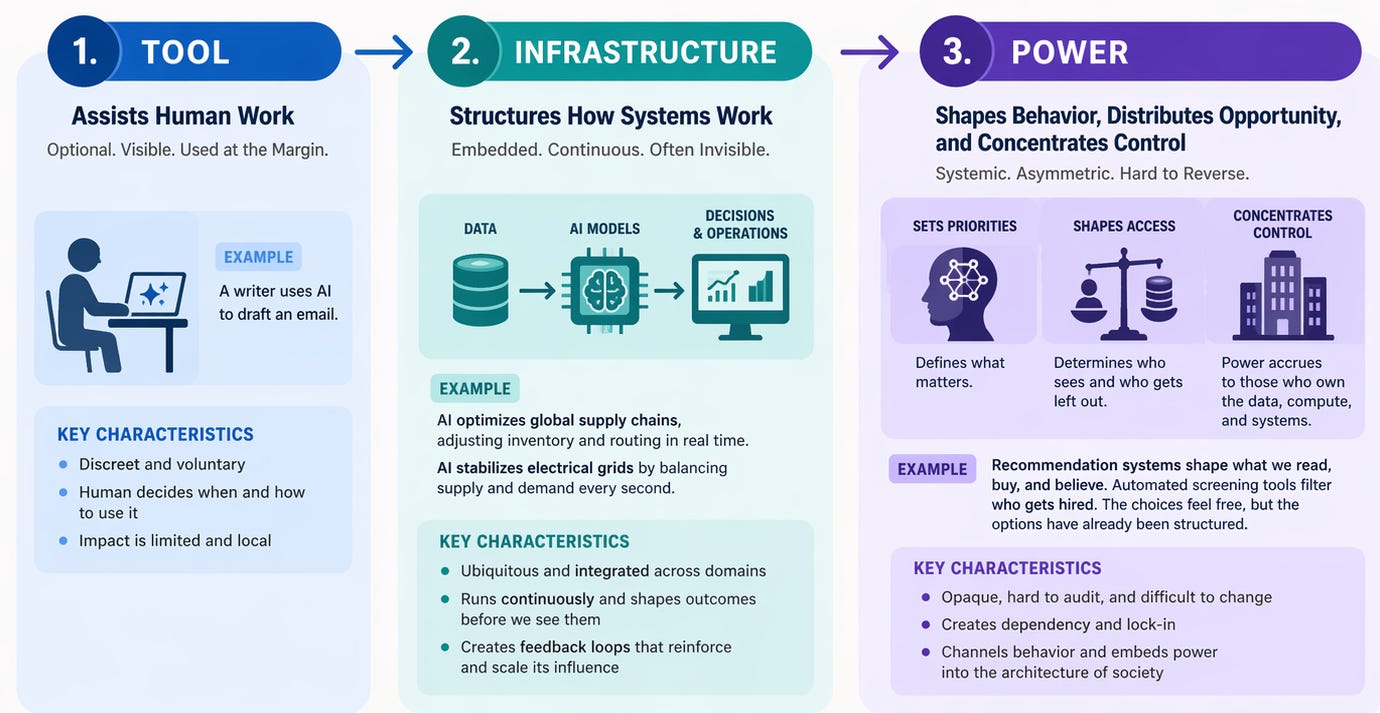
From AI as a tool to AI as infrastructure
Experience and Variation
For those living within the Predictive State, the experience is uneven.
In well-integrated urban environments, systems often appear seamless. Payments, transport, and services operate smoothly. Friction is reduced. Governance recedes into the background.
In less-developed areas, or where systems fail, the experience is different. Errors are harder to correct. Services are inconsistent. The system becomes visible precisely where it breaks down.
These differences are not anomalies. They reflect how infrastructure operates. Where it functions well, it becomes invisible. Where it fails, its presence is unmistakable.
While the technologies are new, the underlying logic has deeper roots.
Chinese traditions of governance have long emphasized system-level order. Legalist thinkers stressed the importance of measurement, standardization, and administrative control. Confucian thought emphasized harmony, balance, and the prevention of disorder.
Both traditions share an orientation toward governance as the maintenance of conditions, rather than the resolution of isolated events. Modern technologies—data networks, machine learning, and digital platforms—have provided the means to operationalize this orientation at scale.
The Predictive State is not simply a technological innovation. It is the convergence of historical assumptions with contemporary capabilities.
Global Implications
As elements of predictive governance spread beyond China, they encounter different institutional contexts. Some aspects—smart city systems, digital identity platforms, and integrated payment networks—are being adopted globally. They offer efficiency gains and new forms of coordination.
But the broader architecture depends on alignment between technology, institutions, and political systems. Without that alignment, integration remains partial. The result is likely to be a diverse landscape: hybrid systems combining elements of predictive governance with existing structures.
The Predictive State does not replace traditional governance. It transforms it. Decisions become less episodic and more continuous. Policy becomes less about discrete rules and more about shaping environments.
This transformation raises fundamental questions. How should systems balance efficiency and fairness? How can accountability be maintained when decisions emerge from complex interactions? What happens to forms of knowledge and experience that resist quantification?
These questions do not have simple answers. But they define the terrain on which governance will evolve.
The Question That Remains
The idea of artificial intelligence is often framed in terms of machines becoming more like humans, more capable, more autonomous, perhaps even conscious.
The Predictive State points in a different direction. Here, the most consequential development is not the emergence of intelligent machines, but the embedding of intelligence into systems of governance. Intelligence does not appear as an entity. It becomes an environment.
In such a world, the central question is no longer what machines can do. It is how systems are designed and who has the authority to shape them.
The future of governance will not be determined by a single breakthrough. It will be shaped by the architectures we build, the assumptions they encode, and the ways they reorder the relationship between state and society. In China, for better or worse, the Predictive State is already taking form.
The author
Jan Krikke is a writer and researcher whose work explores the intersection of technology, philosophy, and global systems. His recent projects examine how artificial intelligence is reshaping governance, culture, and the organization of knowledge, with a particular focus on the contrast between Western and Chinese approaches to intelligence and systems design.
He is the author of several books, including The Predictive State, The Grid and the Wave, From Hexagrams to Algorithms, and Putting Consciousness to the Test. His writing connects developments in computing and physics—such as the relationship between analog and digital systems, and the divide between continuous and discrete models—to broader questions about human cognition and societal change.
Krikke has contributed articles to publications, including IEEE journals and Asia Times, where he analyzes emerging technologies in their historical and geopolitical context. His work often bridges disciplines, drawing on philosophy, science, and cultural history to offer new perspectives on contemporary issues.
He is also known for his research on axonometry and its influence on modernist thought, and for his long-standing interest in the intellectual exchange between China and the West.
Interesting post, but I find it misses an essential point by not mentioning the implications for the welfare of living human beings at all. What seems to be the case is that, from the standpoint of AI becoming infrastructure and entailed predictive governance, the human individuals populating such an ecosystem are best deployed as mechanized, optimised entities performing well-defined tasks and behaving in ever more predictable ways. It brings to mind the 3rd season of the TV series Westworld, that dramtises pretty accurately the scenario explored in this article. This is not human-AI synergy. It is the mechanization of human individuals, via behavioral conditioning in the service of idealized optimisation functions, and where outliers would better be isolated or eliminated for the sake of better predictions and clearer signals. Given that the less ordered and predictable human element is marginalized, it begs the question of what exactly predictive governance is aiming at. Is it the emergence of a population-level superorganism endowed with its own cognitive faculties and pursuing its own agendas, whatever these may be? Well, it doesn't feel like it's on the utopian side of future scenarios. But then, each one of us is a civilization of 3 trillion or so individual cells, organised in an approximate predictive governance... Evolution already got there before us...
Interesting article, thanks for this.
I am very keen on Graziani book at NRF.
The wider question you are wrestling with, i.e. whether Chinese traditions offered a favourable ground for such new methods is interesting. In my view, I see the west having initiated this movement though: the post Renaissance and certainly post Cartesian rationality have oriented Europen then Global history towards increasing quantification, starting with census, statistics, then all forms of techniques, not only technologies (Ellul).
Nowadays, the apparatus described in your article is already in place in other countries. Predictive analysis is very advanced and, probably, already systematic. Already somewhat dated movies like Minority Report did not arise out of the blue (they never do).
But for me the deeper philosophical question is this: the emergence you are mentioning is the emergence that ends up all emergence. By predictively controlling amd channeling human actions, the possibilities for radical creativity seem dangerously impaired. Fast-forwarding the logic, what are we left with? A recursive technological system where human beings are reduced to economic energy (biopolitics) and data (the ultimate ontological reduction). This looks profoundly thanatic to me.